Sonia Marsh - Gutsy Living

Life's too short to play it safe

  • Home
  • About Sonia
  • Blog
    • Starting Over
    • Solo Cruising
    • Travel & Adventure
    • Peace Corps
    • Writing & Publishing
  • Books
    • Freeways to Flip-Flops
    • My Gutsy Story® Anthology
  • Media
    • Press Kit +Videos
    • Print Media
    • Awards-Reviews-Testimonials
    • Sonia’s Blog Tour
  • Contact
You are here: Home / Archives for Lesotho

Is Medication Overprescribed in Lesotho?

September 18, 2016 by Sonia Marsh 7 Comments

medicine


After living in Lesotho for almost a year, I have experienced two cases of overprescribed medication and agree with the results of a new study that shows that:

“Doctors in sub-Sahara Africa generally prescribe more drugs than the number recommended by the World Health Organization.”  published in the BMC Public Health Journal,

I have experienced two cases of individuals who were given 4-5 medications, and one injection for:

1). A cold

The seventeen-year-old daughter of my host family during Peace Corps training woke up with a cough, and what appeared to me to be the common cold. She did not want to miss school so on her way, she stopped at one of the new clinics built by American donor funding, and was given five plastic bags of different medications, including an antibiotic, plus one injection.

The following day, I asked her if she felt better, and she said, “No.”

I asked her if she saw a doctor, and she replied, “There are no doctors at the clinic.”

2). Allergies/Hay fever

A fourteen-year-old girl at my school could not keep her eyes open during my English class. She said she had allergies and both eyes were swollen with tears streaming down her cheeks. She used her sleeve to wipe them away.

I could tell she was in pain, and asked if she had medicine to take.

“Yes, teacher,” she said. “The clinic gave me an injection and four medicines.”

“Aren’t they helping?”

“No teacher.”

“Come with me and I’ll give you some drops to clean your eyes.”

“Thank you teacher.”

She told me she lived with her grandma, and as I held onto her elbow so she wouldn’t trip over the rocks, I wondered if she was an orphan.

“Here put on my sunglasses.”

She could barely open her eyes, and I wasn’t sure whether to speak to her, or to remain quiet during our fifteen-minute walk home.

Inside my rondavel, I told her to lean back on my pillows so I could place a few drops of “Refresh tears” into her eyes, to flush out any pollen, or other irritant.

She didn’t seem to feel better, so I gave the special Milky Way bar I’d been saving for when I needed to give someone a treat. As with all children at my school, they rarely get candy, so she nibbled it so it would last.

She sat on my couch looking miserable. I found my Peace Corps medical kit wondering if I had any medication for allergies. I’d forgotten I had antihistamines, and was so happy to give her a few pills. She took one, trusting me completely, and after twenty minutes or so, her eyes were dry. They still hurt, but she wanted me to show her my photos on my laptop. I was so happy to make her feel better.

3). High blood pressure
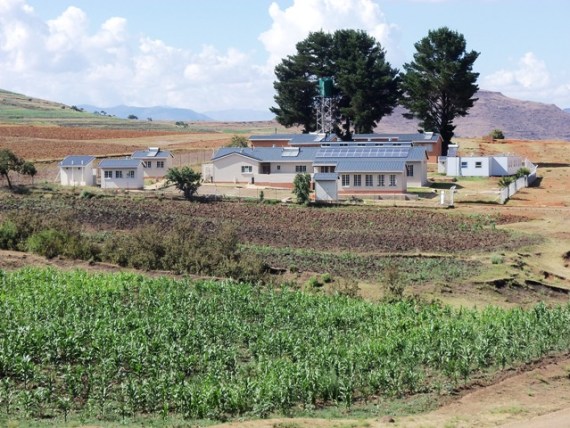
american-built-clininc
Donor Funding by Millenium Corporation

I visited a beautiful clinic built with American donor funding. I was invited to speak to the nurses, even while they were attending to patients.

A woman needed her blood pressure checked to renew her medication, and the nurse told me:

“The blood pressure cuff doesn’t work; the batteries are dead.”

“Don’t you have a manual one?” I asked.

“No.”

At least fifteen patients lined up for their small plastic bags of pills, which are then put into a brown paper bag. When I asked my host mother if the person counting the pills was a pharmacist, she replied,

“No. She just helps.”

I listen to BBC World News daily, and on August 22nd, 2016, (Scroll down) they talked about the study published in the BMC Public Health Journal, which stated:

“A new study has found that doctors in sub-Sahara Africa generally prescribe more drugs than the number recommended by the World Health Organization. 

The study, published in the BMC Public Health Journal, reveals that a patient seeking treatment in the region is likely to be asked to take more medicine than they should ideally be given leading to misuse or overuse of drugs.

The researchers also found that half the time, one is likely to be given an antibiotic, often, without being tested.”

From the three examples I’ve come across, this is happening in Lesotho, and as far as the clinics I’ve visited, there are no doctors, only nurses, and the one time I saw the woman dispensing medication, she was not a qualified pharmacist.

This is a huge problem as far as I can see, not only in terms of a waste of “free” medication, but also dangerous to the patients, in terms of adverse effects.


Update on My Lesotho Community Project

September 11, 2016 by Sonia Marsh 8 Comments

crowd
Parents and grandparents attending the village “pitso” meeting at my school to discuss the community development project.


I’ve been working hard and fast to submit the application to start funding my Peace Corps Community Project. As you can see, the roof and ceiling collapsed at my school, and I hope you can help fund my Lesotho community project, when the Peace Corps accepts, and posts the link to funding my project on their website.

3 goals for my Lesotho Community Project are:
  1. To create a safe classroom environment, by fixing the collapsed roof and ceiling in grade 5.
  2. To wire eleven classrooms providing electricity for lighting, heating during cold winters, and computer literacy.
  3. To improve classroom safety and cleanliness by installing vinyl floor tiles.

As you can see from the photo below, I’m worried that the rest of the roof is going to collapse on my students, so I hope to get started as soon as possible.

Roof and ceiling in my 5th grade classroom

Here’s what I’ve done:

  • Held a village “pitso” meeting at school, explaining the 3 goals of the community project, and making sure that there is interest, and a 25% contribution from members, in order to ensure sustainability. The parents agreed to pay 10 rand each towards hiring a cook to feed the workers. (This is important in Lesotho.)
  • Received quotations from various contractors, and suppliers. My counterpart selected the local contractor who maintains the village high school, and who was recommended by my village chief.
  • Drawn up a detailed contract of the three phases of the project, the materials and transportation required, a detailed timeline, and a specific clause on how to handle theft of tools and/or materials. Also a payment schedule with signatures from the local chief, contractor, supervisor, myself and two witnesses.

I have made friends with a couple of expats who run businesses in Lesotho, and who alerted me to some of the pitfalls, and how to overcome them. Having the contract and making the village chief responsible for supervising the project, were ideas that I had not thought of myself.

I was also able to get price quotations on materials, like floor tiles and glue, from these local business expats who know where to go, and how to get discounts.

bad-floor-in-grade-2
Cracked cement floor. Want to tile the floor for the cold winters and cleanliness.

I submitted my proposal to the Lesotho Peace Corps office, and hope to hear back from them soon, so that Peace Corps Washington DC can get the link for funding my project as soon as possible.

My goal is to raise $5,000,  and to finish all the work by November 15th, 2016. Maybe this is wishful thinking, but I believe it can be done.

If you are able to help donate funds for my community development project, please keep reading my weekly blog, or sign up to receive my blog posts on the right side of my landing page. (See photo below where to sign up on my blog page: (http://Soniamarsh.com)

landing-page

I’ll post the link for donations, once the Peace Corps has approved my submission.

Thanks for your interest.

Online Dating: My Coping Mechanism for Boredom

August 28, 2016 by Sonia Marsh 11 Comments

Sonia dating-3

The Peace Corps warned us that boredom and loneliness may cause a problem at times, and asked us to think of some coping mechanisms. I came up with a new one: online dating.

My days are busy with teaching, but evenings and weekends can become quite lonely, and boring in my rural village in Lesotho. It’s quite common for Peace Corps Volunteers (PCVs) to get depressed between months six to nine of service. We were shown a graph depicting the highs and lows experienced by PCVs during our ten-week training session.

Apart from spending time with my “host mother” and other activities such as lesson planning, writing my blog, reading, e-mailing, talking to family and friends on WhatsApp, knitting, drawing, walking, cooking, cleaning and hand-washing my clothes, I’ve added online dating as another form of entertainment.

The winter months can be brutal here in “The Mountain Kingdom,” where the sun sets at 5:20 p.m., and there is no heating, so I snuggle up in my sleeping bag and prop my laptop on top of my pillow, making sure the battery is fully charged.

I’m a realist knowing that my online dating will stay online. What man would seriously consider flying all the way to Lesotho to my rondavel out in the boonies? In a sense I’m not dating but simply “networking.”

So how can online dating be entertaining? If you’ve never tried it, let me share some of my experiences, and warn you about potential scammers.

“With 54 million single people in the U.S. 49 million have tried online dating, that’s 90% according to statisticbrain.com.”

Since I’m cheap, especially on my PC stipend of $150/month, I refuse to pay for online dating services, until I move to a country where I can actually meet someone in person. So I’ve joined free sites, and hope that I might be lucky enough to find a man who means what he says.

From my collection of e-mails, a striking pattern has emerged. Apart from that one man who said, “I’ll commit suicide right now if you don’t tell me why you’re not interested in me,” the other men all claim to be engineers, military guys, and quite shockingly, they all seem to have lost their wife to cancer, or a car accident.

At first, I felt sorry for them, but after receiving similar stories, I realized they were scammers preying on women who might fall for their sob-stories.

I compared notes with another PCV in Lesotho, my age, who is also online dating, and she said these men post photos of handsome men, who are not them, and after a while, ask you to send money. (Might that be a new version of the infamous Nigerian scammers?) They make up some excuse like their son or daughter needs surgery, or they lost their business. This has not happened to me yet. I usually quit writing immediately. So now when I receive a FB friend request from a man who says:

“Hi Sonia , how are you doing ? thanks for accepting, I do really appreciate  , can we get to know each other better if you don’t mind? my name is A …” (My reply.)

“We can, as long as you don’t tell me that your wife died and that you are lonely. I ‘ve received at least ten messages from military men and engineers who state the same thing.”

When they don’t respond, I know they were like the others I received.

I joined a travel dating site, as I’d like to have a male travel companion to tour Africa, and noted that many of them are over 75. I’m sorry, they may be great men, but I want someone closer to my age for travel and adventure.

Some guys can be quite funny:

“Hi Sonia, how are you ? I like your comments & would like to travel with you ! How can we do this, shall I approach it like a job application ? HaHa please see my profile & CV / Referees on linkedin . LOL G.”

I’m not a professional editor or proof reader, and admit that I make mistakes in my writing, however, dating scammers seem to have:

  • Bad grammar, (especially when the person tells you that he has a Masters degree, and attended a private high school in Monaco.)
  • Use lower case (i)
  • Use run-on sentences
  • Do not indent their paragraphs
  • Offer false information like, “I own a diamond mine in Botswana.”

I won’t give-up. I am human after all, and know that one day, I’ll find the “right” male companion, whether online, or in-person.

In the meantime, I might just continue online dating for entertainment, although now I have a new focus which you’ll hear more about next Sunday: My Community Development Project, and how I’m pushing it along.

Do you have any similar online dating experiences? If so, please share them.

When to Give Money and When Not To

August 21, 2016 by Sonia Marsh 10 Comments

old lady

One of the challenges I face while serving as a Peace Corps Volunteer in Lesotho, Africa, is when to give money and when not to. My views on this matter are constantly changing based on what I’ve learned during the last ten months.

Today I was put in a difficult situation. My host mother, Mary, whom I truly care for, asked me to visit her “sister.” Since Mary calls everyone in my village her “sister,” including me, I’m never sure who is a blood relative, and who isn’t.

This poor lady is 76-years-old, and due to the heavy rainstorm we had two days ago, the interior part of her wall fell onto her mattress.

She started crying, saying “Mathata, mathata,” (problem, problem) as I stood there not knowing what to say, except that she was fortunate it happened during the daytime, rather than at night. Even Mary said it would have crushed her ribs, had she been sleeping.

old lady wall collapsed
stone wall collapsed onto her mattress

Since I’m already involved with a community development project: to fix the roof and wire the school in my village through the Peace Corps Partnership Program (PCPP), I get the impression my village believes I’m going to fix their houses as well.

What is frustrating is that I would like to help, but as a Peace Corps volunteer, we are not expected to “give” handouts. We are here to work on sustainable projects where the community participates by offering 25% of the cost, either through funding, or through their time and effort.

I felt guilty when I left this old lady’s house, so I tried to think of other options. I asked Mary why the young people in our village—most of whom don’t work or go to school—don’t help rebuild this lady’s wall.

“They want money,” she replies.

“But they’re not doing anything all day except sitting outside and watching people go by.”

“Yes, but they don’t want to work,” she replies.

I admit to being surprised since I see the older people in my community supporting one another.

“Does she have children who can help her?” I ask.

“Yes, but they don’t have jobs,” she replies.

“So why can’t they come out and help their mother?”

“They cannot afford a taxi to come out.”

“Can’t they hitchhike, or ask a friend to drive them who has a car?”

Mary shrugs.

I’m almost certain I was taken to the lady’s house to give money. This happens to me quite frequently and I have trouble understanding the conflicting messages I hear from the Basotho.

I’ve been told not to help. “Why?” I asked.

“Because once you help one person, the whole village will gossip, and then they want you to help everyone. It’s because of the color of your skin.”

I remember when Mary told me not to feed the orphan in my village who was begging. “If you feed him, you’ll have all the children asking for food.”

So during my ten months in Lesotho, I’ve followed the advice given to me by my host mother, even in the case of this poor lady. I’ve learned the harsh reality that it’s impossible to help everyone.


My Community Development Project in Lesotho

August 14, 2016 by Sonia Marsh 8 Comments


grade 5 ceiling better
Collapsed grade 5 ceiling at my School in Lesotho

After ten months in Lesotho, I’ve finally figured out a community development project that the principal, teachers and parents at my rural school, show positive signs of being invested in.

My original project of starting a community center took a 180 degree turn following the heavy snows we experienced in July. After several days of continuous snowfall, the frosted pine trees started sagging, causing the loaded branches to snap onto the corrugated tin roof of my school. Imagine my 5th grade students’ faces when they arrived at school on August 1st, the first day of the new quarter, and discovered they no longer had a classroom. My thought was: How and where am I going to teach my kids?

I was given the hall to teach, but it’s next to the outdoor kitchen, where the papa is cooked on a wood burning stove for several hours, and the smoke enters the hall through the broken window panes, facing the kitchen.

Side view of Smoke from kitchen next to grade 5 closer
The outdoor kitchen. Smoke enters the building where I teach grade 5, on the right of the picture.

My eyes sting as I’m not used to smoke. The children cook this way at home, but are also complaining about the smoke in our classroom.

Our temporary classroom

We put the blackboard up against the window to block the smoke. It still enters through the top of the window.

The snow also damaged village priest’s building next to my school. He kept his sheep inside, and they died when the roof collapsed. The community skinned the sheep and dried the hides on his roof.

Roof destroyed on building
Snow caused the roof to collapse on the Priest’s building where he was sheltering his sheep from the cold. They all died.
sheep skins drying on roof
Sheep skin drying on priest’s roof.

Everything takes forever to fix when you live in a rural village in Lesotho. There is no “Home Depot” or small hardware store, let alone skilled labor in my village. That’s not surprising, as there isn’t even a store to buy fresh vegetables, fruits or meat, unless you drive to the closest town: an hour by public transport.

The second problem, which I’m used to hearing at my school in Lesotho is: “There’s no money.”

I decided to prioritize the rebuilding of the classroom, and to add another pressing need I’m excited to share with you as the students are eager to learn this important skill.

The community wants to wire the entire school now that our village has electricity.

Only the staff room is wired for electricity at my school. It’s about time that all the classrooms get electricity. In winter, we have to keep the doors open to get sufficient light to see the blackboard. Icy winds blow inside the classroom, and both the teachers and a few students who can afford it, are wrapped from head to toe in the traditional Basotho blankets.

The Minister of Energy donated four computers and a printer to our school when the electricity was officially turned on. I haven’t been able to set them up. Why?

1). They’re locked up in the principal’s convent.

2). We don’t have burglar bars installed on the windows so they might get stolen.

3). We don’t have electricity in the classrooms; only the staff room.

Computers from Minister-3
7th grade students showing off the new computers, printer and monitors , donated by the Minister of Energy.

We just received the new curriculum from the Ministry of Education, and teaching students how to use a computer is now on the syllabus. There are no more excuses for not removing the computers from the convent, where they are collecting dust.

If I can raise enough money, the principal and teachers would also like to have linoleum floors installed on the broken concrete slabs in the classrooms. Only the staff room and grade 7 have linoleum floors, but all the other classrooms have these ugly, cracked, cold floors.

Bad floor in grade 2

One of the key components to the success and sustainability of a community development project is to:
  • Form a community committee with specific roles for volunteers
  • Ask for community contribution, not necessarily in cash, but in preparing lunch for the workers, painting the classroom, offering any skills they may have
  • Try to get the community to help with transportation of supplies and labor

After my counterpart, the principal and I put together a community committee to determine the goals and objectives, receive quotes for the repairs, costs of materials, supplies and equipment, and all has been approved by the Peace Corps, I am going to accept donations for my school, through the Peace Corps website.

I hope you will be able to help make this community development project a success, and promise to do my utmost to speed things up, and give the kids a better learning environment.

I will keep you updated once everything is approved, and we can start the community development project. Please be patient, (something I’m still learning) everything takes time here. Please share my post if you know someone who might like to help with my community development project.


« Previous Page
Next Page »
  • Facebook
  • Instagram
  • LinkedIn
  • Pinterest
  • Twitter
  • YouTube

Sign up for my Gutsy Updates

Sign up to receive awesome content in your inbox, every month.

We don’t spam! Read our privacy policy for more info.

Check your inbox or spam folder to confirm your subscription.

Welcome to My New Life

Welcome to My New Life

Do you feel trapped?
Let me Help You Rediscover Your Freedom.
I divorced at 58, and now belong to myself.
If I can do it, so can you!
Let me help you find your purpose and become your own best friend.

Click the cover to buy on Amazon

Recent Posts

  • Do You Really Want to Live to 120? The Truth About Healthspan vs. Lifespan
  • I’ve Forgotten How to Drive — My Tesla’s Drives Better Than Me
  • Why I Quit Dating Apps at 68—And My 35-Year-Old Son Has the Same Problem

Also Available At:

Latest from the blog

  • Do You Really Want to Live to 120? The Truth About Healthspan vs. Lifespan
  • I’ve Forgotten How to Drive — My Tesla’s Drives Better Than Me
  • Why I Quit Dating Apps at 68—And My 35-Year-Old Son Has the Same Problem
  • Solo Cruising Doesn’t Mean You’re Alone
  • Single Woman Cruising Solo

Top Posts

  • From Rice and Lentils to Salmon and Champagne
  • "My Gutsy Story" by Rebecca Hall
  • Pregnant at 53
  • My Road to Becoming an Author by Jonathan Yanez
  • My First Basotho Funeral
  • Privacy Policy

Copyright © 2026 · Beautiful Pro Theme on Genesis Framework · WordPress · Log in

Loading Comments...