Sonia Marsh - Gutsy Living

Life's too short to play it safe

  • Home
  • About Sonia
  • Blog
    • Starting Over
    • Solo Cruising
    • Travel & Adventure
    • Peace Corps
    • Writing & Publishing
  • Books
    • Freeways to Flip-Flops
    • My Gutsy Story® Anthology
  • Media
    • Press Kit +Videos
    • Print Media
    • Awards-Reviews-Testimonials
    • Sonia’s Blog Tour
  • Contact

Not Being Politically Correct May Shock You

October 2, 2016 by Sonia Marsh 22 Comments

cows-on-walk-to-post-office

People are not “politically correct” in my village in Lesotho. This may shock you.

In America we try to be “politically correct” so as not to offend someone. There are certain things we would never say, however in Lesotho, being “politically correct” seems to be different.

As a Peace Corps volunteer in Lesotho, I’ve been quite surprised to hear how some of my students describe their friends, and how people I’ve met in my village, describe one another.

When my students wrote an essay about a person they admire, they all wrote about a relative or a friend. Some of them described their friend as follows:

“She has a big nose, dark complexion, and her body is like a big cow.”

I don’t think a teacher in the U.S would let a teenager get away with this description in the U.S. The funny thing is this does not offend the Basotho. In fact it seems to be a compliment as I’ve been told by many women that Basotho men prefer large women. It’s a sign of being healthy when a woman is big. Lesotho and South Africa are countries where being obese is beautiful according to a survey, the reason being:

“Due to the prevalence of AIDS, the association between weight loss and illness has contributed to South Africa’s negative view of thinness.” Read article.

I remember watching a show on “Oprah” many years ago about what is considered beautiful in different parts of the world, and in Mauritania, West Africa.

“In this drought-ridden west African nation, female obesity is synonymous with beauty and wealth.  Though less common, “gavage” (borrowed from the French to describe fattening a goose’s liver destined for foie gras) is still practiced, with young girls imbibing vast qualities of fatty camel milk daily.” Read article.

Another situation I encountered regarding this topic of being “politically correct” was in a public taxi on my way to Maseru.

A woman asked me if I knew “so-and-so” in my village, and I said, “No.”

She then tried to describe her as, “The one with the monkey face.”

I was stunned.

I was even more shocked when I heard a Basotho radio host talking about his co-host in English and said, “You have a monkey face,” and started howling with laughter.

So I guess, we have to be open to different ways of viewing what is politically correct in our society.

Who Are You?

September 25, 2016 by Sonia Marsh 7 Comments

sonia-with-list-of-jobs
Who are you?

When I first moved to my village in Lesotho, Africa, everyone asked me “Who Are You?

It wasn’t until I read a blog post entitled: “One Question You Should Ask Everyone You Meet,”

“Who Are You?”

instead of:

“What Do You Do?”

by Marc & Angel on Life Hacks, that I started to see a difference in how cultures relate to one another.

When I lived in Orange County, California, people were quick to ask one another, “What do you do?” It used to irritate me as it seemed like we were judging one another’s level of education, and socio-economic status, just by asking that question.

“We seem to value people’s ‘doing’ more than who they are as a person.” Marc & Angel.

Now that I’m living in a tiny village in Lesotho, Africa, I’m equally irritated by the question, “Who Are you?”  Ke mang?   At first I found this question intrusive. “Can’t they see I’m a white, middle-aged woman?”

What the Basotho in rural areas want to know is, “What’s my name? Where am I from? What village do I live in? and Where am I going?” (even when I’m on my early morning walk.)

It occurred to me that maybe the Basotho truly care enough about me to get to know me; something that we may have lost in the first world, where we are competitive, comparing ourselves and our self-worth based on our jobs, and what we own.

“Are we interested enough in what we can learn from each other, to stop asking, “What do you do?” and start asking, “Who are you? What is your life story?” Marc & Angel.

I’ve always been interested in life stories and love asking people about their goals in life, and lessons learned. But truthfully, if I asked people questions 3-7 below, (Questions suggested by Marc & Angel) when I first met them, I think they would be shocked.

  1. Where were you born?
  2. Where do you live now?
  3. What makes you smile?
  4. What is the most important life lesson you’ve learned so far?
  5. What is your deepest fear?
  6. What is your greatest dream for your life?
  7. Who are you?

Since I moved to Lesotho to serve as a Peace Corps volunteer, I’ve been asked questions 1, 2 and 7, almost daily. I judged the Basotho as being nosy, and gossipy, and since I cannot communicate intelligently in their language, (Sesotho), I would get irritated with their insistence.

Now, I realize that perhaps they are interested in knowing more about my own life story, and that I might have been too quick to judge them as nosy, and “none of their business.” Imagine if we all cared enough about each other to find out the answers about “Who Are You?”

So I’m going to ask you, “Who are you?” Many of us are not sure about how to answer this question.

Are you?

I’d love to hear back from you.


Is Medication Overprescribed in Lesotho?

September 18, 2016 by Sonia Marsh 7 Comments

medicine


After living in Lesotho for almost a year, I have experienced two cases of overprescribed medication and agree with the results of a new study that shows that:

“Doctors in sub-Sahara Africa generally prescribe more drugs than the number recommended by the World Health Organization.”  published in the BMC Public Health Journal,

I have experienced two cases of individuals who were given 4-5 medications, and one injection for:

1). A cold

The seventeen-year-old daughter of my host family during Peace Corps training woke up with a cough, and what appeared to me to be the common cold. She did not want to miss school so on her way, she stopped at one of the new clinics built by American donor funding, and was given five plastic bags of different medications, including an antibiotic, plus one injection.

The following day, I asked her if she felt better, and she said, “No.”

I asked her if she saw a doctor, and she replied, “There are no doctors at the clinic.”

2). Allergies/Hay fever

A fourteen-year-old girl at my school could not keep her eyes open during my English class. She said she had allergies and both eyes were swollen with tears streaming down her cheeks. She used her sleeve to wipe them away.

I could tell she was in pain, and asked if she had medicine to take.

“Yes, teacher,” she said. “The clinic gave me an injection and four medicines.”

“Aren’t they helping?”

“No teacher.”

“Come with me and I’ll give you some drops to clean your eyes.”

“Thank you teacher.”

She told me she lived with her grandma, and as I held onto her elbow so she wouldn’t trip over the rocks, I wondered if she was an orphan.

“Here put on my sunglasses.”

She could barely open her eyes, and I wasn’t sure whether to speak to her, or to remain quiet during our fifteen-minute walk home.

Inside my rondavel, I told her to lean back on my pillows so I could place a few drops of “Refresh tears” into her eyes, to flush out any pollen, or other irritant.

She didn’t seem to feel better, so I gave the special Milky Way bar I’d been saving for when I needed to give someone a treat. As with all children at my school, they rarely get candy, so she nibbled it so it would last.

She sat on my couch looking miserable. I found my Peace Corps medical kit wondering if I had any medication for allergies. I’d forgotten I had antihistamines, and was so happy to give her a few pills. She took one, trusting me completely, and after twenty minutes or so, her eyes were dry. They still hurt, but she wanted me to show her my photos on my laptop. I was so happy to make her feel better.

3). High blood pressure

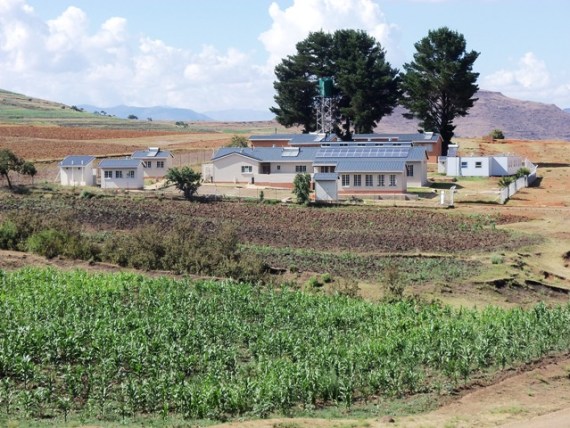
american-built-clininc
Donor Funding by Millenium Corporation

I visited a beautiful clinic built with American donor funding. I was invited to speak to the nurses, even while they were attending to patients.

A woman needed her blood pressure checked to renew her medication, and the nurse told me:

“The blood pressure cuff doesn’t work; the batteries are dead.”

“Don’t you have a manual one?” I asked.

“No.”

At least fifteen patients lined up for their small plastic bags of pills, which are then put into a brown paper bag. When I asked my host mother if the person counting the pills was a pharmacist, she replied,

“No. She just helps.”

I listen to BBC World News daily, and on August 22nd, 2016, (Scroll down) they talked about the study published in the BMC Public Health Journal, which stated:

“A new study has found that doctors in sub-Sahara Africa generally prescribe more drugs than the number recommended by the World Health Organization. 

The study, published in the BMC Public Health Journal, reveals that a patient seeking treatment in the region is likely to be asked to take more medicine than they should ideally be given leading to misuse or overuse of drugs.

The researchers also found that half the time, one is likely to be given an antibiotic, often, without being tested.”

From the three examples I’ve come across, this is happening in Lesotho, and as far as the clinics I’ve visited, there are no doctors, only nurses, and the one time I saw the woman dispensing medication, she was not a qualified pharmacist.

This is a huge problem as far as I can see, not only in terms of a waste of “free” medication, but also dangerous to the patients, in terms of adverse effects.


Update on My Lesotho Community Project

September 11, 2016 by Sonia Marsh 8 Comments

crowd
Parents and grandparents attending the village “pitso” meeting at my school to discuss the community development project.


I’ve been working hard and fast to submit the application to start funding my Peace Corps Community Project. As you can see, the roof and ceiling collapsed at my school, and I hope you can help fund my Lesotho community project, when the Peace Corps accepts, and posts the link to funding my project on their website.

3 goals for my Lesotho Community Project are:
  1. To create a safe classroom environment, by fixing the collapsed roof and ceiling in grade 5.
  2. To wire eleven classrooms providing electricity for lighting, heating during cold winters, and computer literacy.
  3. To improve classroom safety and cleanliness by installing vinyl floor tiles.

As you can see from the photo below, I’m worried that the rest of the roof is going to collapse on my students, so I hope to get started as soon as possible.

Roof and ceiling in my 5th grade classroom

Here’s what I’ve done:

  • Held a village “pitso” meeting at school, explaining the 3 goals of the community project, and making sure that there is interest, and a 25% contribution from members, in order to ensure sustainability. The parents agreed to pay 10 rand each towards hiring a cook to feed the workers. (This is important in Lesotho.)
  • Received quotations from various contractors, and suppliers. My counterpart selected the local contractor who maintains the village high school, and who was recommended by my village chief.
  • Drawn up a detailed contract of the three phases of the project, the materials and transportation required, a detailed timeline, and a specific clause on how to handle theft of tools and/or materials. Also a payment schedule with signatures from the local chief, contractor, supervisor, myself and two witnesses.

I have made friends with a couple of expats who run businesses in Lesotho, and who alerted me to some of the pitfalls, and how to overcome them. Having the contract and making the village chief responsible for supervising the project, were ideas that I had not thought of myself.

I was also able to get price quotations on materials, like floor tiles and glue, from these local business expats who know where to go, and how to get discounts.

bad-floor-in-grade-2
Cracked cement floor. Want to tile the floor for the cold winters and cleanliness.

I submitted my proposal to the Lesotho Peace Corps office, and hope to hear back from them soon, so that Peace Corps Washington DC can get the link for funding my project as soon as possible.

My goal is to raise $5,000,  and to finish all the work by November 15th, 2016. Maybe this is wishful thinking, but I believe it can be done.

If you are able to help donate funds for my community development project, please keep reading my weekly blog, or sign up to receive my blog posts on the right side of my landing page. (See photo below where to sign up on my blog page: (http://Soniamarsh.com)

landing-page

I’ll post the link for donations, once the Peace Corps has approved my submission.

Thanks for your interest.

Recycling Trash to Toys

September 4, 2016 by Sonia Marsh 10 Comments

A boy made this car from my toothpaste box


Twice a week, I burn my trash in a small pit outside my rondavel.

Tremendous guilt sets in the minute I strike the match, realizing that I’m contributing towards global warming. Each time, I’m surprised to see how easy it is to burn plastic bags and Styrofoam packaging trays. The fact that this is a big, “No-No” in many parts of the western world, with strict recycling laws, adds to my sense of wrongdoing.

The problem is, I have more trash than the Basotho because I buy mushrooms, zucchini, broccoli, and cauliflower, imported from South Africa, and packaged in Styrofoam trays. These vegetables are not part of the Basotho diet in my rural village.

When I first posted photos of my “Lack of Privacy” in my village, and how everyone is interested in what I’m burning, my author friend, Ian Mathie, mentioned letting my students figure out what the children can make from my “trash.”

I procrastinated for several reasons:

  • I wanted to collect enough items of the same kind, for example, 16 Styrofoam trays or milk cartons, so everyone would be working on that same item. It would take me forever to eat 16 trays of mushrooms.
  • I didn’t want to use my own data to pull up step by step ideas from the Internet, and my Principal, didn’t want to offer to pay. “There’s no money,” she would say.
  • I didn’t have enough ideas to make something without the right supplies for that project.

Then, last week, I’d collected a huge plastic bag full of many recyclable items, and carried it to my Grade 5 students.

When I opened the bag, and displayed all the objects on the table, the kids went crazy. They wanted those empty yoghurt cartons, empty toothpaste boxes, and fought over them, as though I’d offered them brand new toys.

My 5th grade students have picked out the trash items they wanted.

I told them to take the items home, and to bring them back the next day, with their “creations.”

Honestly, I felt relieved to get rid of my waste, and not have to burn it, but did not expect them to make anything from it.

The following morning, the children were so excited to show me their creations, and I was blown away. I did not realize the kids could be so creative with recycling trash to toys.

Car made from printer cartridge
Car with wheels
Bucket from yoghurt cartom
He used it to food

I had underestimated my 5th grade Basotho students ability to come up with something, but when you can’t afford toys, it’s amazing what you can make from “trash.”


« Previous Page
Next Page »
  • Facebook
  • Instagram
  • LinkedIn
  • Pinterest
  • Twitter
  • YouTube

Sign up for my Gutsy Updates

Sign up to receive awesome content in your inbox, every month.

We don’t spam! Read our privacy policy for more info.

Check your inbox or spam folder to confirm your subscription.

Welcome to My New Life

Welcome to My New Life

Do you feel trapped?
Let me Help You Rediscover Your Freedom.
I divorced at 58, and now belong to myself.
If I can do it, so can you!
Let me help you find your purpose and become your own best friend.

Click the cover to buy on Amazon

Recent Posts

  • Do You Really Want to Live to 120? The Truth About Healthspan vs. Lifespan
  • I’ve Forgotten How to Drive — My Tesla’s Drives Better Than Me
  • Why I Quit Dating Apps at 68—And My 35-Year-Old Son Has the Same Problem

Also Available At:

Latest from the blog

  • Do You Really Want to Live to 120? The Truth About Healthspan vs. Lifespan
  • I’ve Forgotten How to Drive — My Tesla’s Drives Better Than Me
  • Why I Quit Dating Apps at 68—And My 35-Year-Old Son Has the Same Problem
  • Solo Cruising Doesn’t Mean You’re Alone
  • Single Woman Cruising Solo

Top Posts

  • From Rice and Lentils to Salmon and Champagne
  • "My Gutsy Story" by Rebecca Hall
  • My Road to Becoming an Author by Jonathan Yanez
  • My First Basotho Funeral
  • Reinventing Myself in Mid-Life
  • Privacy Policy

Copyright © 2026 · Beautiful Pro Theme on Genesis Framework · WordPress · Log in

Loading Comments...