Sonia Marsh - Gutsy Living

Life's too short to play it safe

  • Home
  • About Sonia
  • Blog
    • Starting Over
    • Solo Cruising
    • Travel & Adventure
    • Peace Corps
    • Writing & Publishing
  • Books
    • Freeways to Flip-Flops
    • My Gutsy Story® Anthology
  • Media
    • Press Kit +Videos
    • Print Media
    • Awards-Reviews-Testimonials
    • Sonia’s Blog Tour
  • Contact
You are here: Home / Archives for Peace Corps

My Experience Working With A Contractor in My Village In Lesotho

November 6, 2016 by Sonia Marsh 15 Comments

sonia-in-front-of-truck

I woke up at 4:20 a.m., excited and anxious about working on a construction project with a local contractor from my rural village in Lesotho, and his team of workers.

I kept my fingers crossed there would be no glitches, and that we’d buy all the materials at the Basotho equivalent of  “Home Depot.” After that, I’d offer lunch to everyone at KFC in Maseru, and then we’d drive back in the rented truck and reach my school by early afternoon. That was my plan.

‘M’e Mamoshaka, a teacher at my school asked me to head over to her house at 6:15 a.m. She likes to sleep late, so I was pleasantly surprised to find her up and dressed. She was frying frankfurters in oil, and wrapped them in two slices of bread and stuffed them in her purse. As we headed out the door, she tossed her empty water canteen to a woman who happened to be heading to the village tap, pushing empty canisters in a squeaky wheelbarrow. I still don’t understand how serendipity works in the Basotho culture. Their timing is perfect, while I’m always struggling with my American time schedule.

Just as we boarded the taxi at 6:33 a.m, the woman handed over the filled water canteen to ‘M’e Mamoshaka, and my contractor, Ntate Makae, magically appeared twenty seconds before our taxi van stopped by his house.

As we headed towards the main taxi rank in Maseru, traffic built up reminding me of the bumper to bumper traffic on the 5 freeway in Los Angeles. The only difference here is that when drivers get impatient, they pull over to the opposite side of the street, and drive on the sidewalk, against traffic. Are you kidding! The driver dodged cars heading straight towards us, as pedestrians jumped for safety. When we finally reached Maseru taxi rank, we headed over to the “Salman” hardware store. The store clerk hand wrote each item we needed, and I soon realized this was no “Home Depot.” After thirty minutes, I pulled out my bank card and paid.

Suddenly, two young men joined us, and I found out that they were here to work with Ntate Makae, so now I believed everything was under control, and well-organized by my contractor.

Co
The Team

An old, beat-up truck pulled over, and a burly man gestured to ‘M’e Mamoshaka and myself to get in the front seat. At first I wondered how all five of us, plus the driver would fit inside, but I’d forgotten that in Lesotho, you can sit in the truck bed without getting arrested.

We headed over to City Lights to purchase the electrical items on our list, but my contractor had forgotten to add a meter box and the extra lights for 11 classrooms.

This time, my bank card was declined, and I panicked. I called the Peace Corps office to ask for advice, and they told me to go to my bank, and get the cash out. I was not keen on carrying cash on the streets of Maseru, but that seemed to be the only way.

So we asked the burly truck driver to take ‘M’e Mamoshaka and me to the bank. His truck wouldn’t start unless it was put into gear and pushed, or faced downhill. We finally got moving, and I started shaking my head when I saw at least 100 people waiting in line outside the bank. The line snaked around the building and I realized there was no way we could stand here. We would waste the whole day to get to the front of the line.

‘M’e Mamoshaka said, “Follow me.” An older woman stood at the information counter, and even she had about ten people waiting to talk to her. ‘M’e Mamoshaka grabbed my elbow, “Wait here.”

As soon as the older woman was free, she asked me to explain my dilemma.

“I will put you in this line today,” the woman said. It was a shorter one with around twelve people, “but next time you have to go to the end of the line.”

I thanked her, and then counted the people in front of me. Two hours later, I was about to strangle someone. I started doing leg lifts, shoulder raises and calf raises, as the blood in my body had stopped flowing. The line barely moved, and with only three cashiers for 100 people, many of them cutting in line, my patience had become non-existent.

When I finally reached the cashier, he asked me for my passport, which I didn’t have with me. I’m always scared it will get stolen in Maseru, and I only take it when I’m crossing the border to South Africa.

I had my California driver’s licence with a photo, and my Peace Corps ID with a photo as well. He didn’t seem to allow either one, until a Supervisor came by and allowed the transaction to proceed. I was just about to explode, and that would not have been a pretty sight.

Our driver stood outside smoking a cigarette. He had positioned his truck facing downhill, so he could jumpstart it.

We returned to City Lights, and I took the cash envelope and requested permission to go behind the burglar bars to count the cash. I’ve never paid for anything with this much cash, and meanwhile, the men loaded the truck.

2-guys
Construction guys helping with electrical

Stupid me kept thinking this truck was a temporary one, and we would transfer everything into a much larger truck later on. I also believed that ‘M’e Mamoshaka and I would have a comfortable seat in the bigger truck, but it wasn’t until we stopped to collect thirty-one, 6 metre (20 foot) wooden rafters, and six 50-kg bags of cement, that I realized Ntate Makae was planning to use this old-piece of shit truck.

Everyone was starving, and I’d told everyone we’d stop for lunch, but they insisted on getting the truck loaded.

Five men sat on crates in the warehouse, doing nothing. We waited thirty minutes, while the truck driver said he needed to fetch gas in a jerrycan. He asked me for money, to buy gas, and we had barely driven anywhere, but he claimed his tank was empty from taking us to the bank.

“He lying,” Mamoshaka said.

“Lets go to KFC and get a private taxi to take us home after that,” I whispered in ‘M’e Mamoshaka’s ear. I had visions of this truck not making it up the mountains to my village, and the guys at the warehouse hadn’t budged in the last thirty minutes from their crates.

A private taxi picked us up after lunch, and we headed back to our village in the mountains.

Afternoon traffic was getting heavy as it approached 4 p.m. I wondered if the truck had left yet, so we called and Ntate Makae who told us they were almost on their way.

‘M’e Mamoshaka and I got home at 5:45 p.m. It was still light and we called Ntate Makae again and he said they were close to my village.

By 7:30 p.m., they were having trouble climbing the mountain; the load was too heavy for the crappy truck, so they were stuck. They had to call a teacher from my school who arranged for a second truck.

It wasn’t until  9 p.m., that I received a call to say they had made it.  Dressed in my pyjamas, I asked Mary my host “mother”  to come with me. I carried my solar light, as I cannot see a damn thing in this rural darkness.

I pointed the light at two trucks outside: one large one, and the small, dilapidated one. All of the heavy stuff, including all the wood, had been transferred to the large truck, which I later found out belonged to one of my teachers at school.

Quite proud of myself for taking the private taxi home, rather than waiting for the truck to make it to my village, I was able to go to sleep and feel satisfied that the team could start work on the following day.

Cultural Differences On How We Treat Dogs

October 30, 2016 by Sonia Marsh 5 Comments


It’s tough for dog-loving people to understand why dogs are treated poorly in many parts of the world.

In the comforts of our homes, we treat our pets like family. We buy them food and toys, we let them climb onto our beds, we cuddle them, we take them to parks so they can play with other dogs, we take them to the vet when they get sick, and we protect them from diseases by giving them their shots. In fact, us dog-lovers treat our dogs like a son or a daughter, and mourn their death, in some cases, more than the death of a relative.

But now I live in a rural village in Lesotho, where people don’t have enough money to buy milk, eggs, and meat to feed their own children, so why should they be able to afford meat, milk and dog food, for their animals?

This post is not meant to make you feel heartbroken for Shaka—the dog that belongs to my Basotho host family–it’s to point out some major cultural differences.

In my rural village in Lesotho, dogs do not sleep in people’s homes; they are solely there to guard the property. I am often awakened by dog fights in the middle of the night, often ending with a dog yelping in pain.

That does not mean I don’t have a heart, and care for Shaka.

In the beginning, Shaka followed me on my early morning walks. She took on the role of protecting me from Bo-Ntate (men) clad in the Basotho blanket. When I passed them on the dirt path, Shaka would start growling at the Bo-Ntate. I knew that sooner or later, one of them would pick up a stone, and throw it at her. My walks became stressful and unpleasant, so I started leaving her home, chained up, which also bothered me.

Shaka recently had her first litter, and Mary, my host “mother” told me her son would take care of the puppies. I believed her, until I heard that he was looking for a job, and was no longer in my village.

puppies
Shaka’s seven puppies

Shaka’s first puppy was born when I unchained her so she could get some exercise. I hated seeing that heavy chain around her neck, but Mary warned me someone could steal her and I didn’t want to be responsible for that. So I asked permission to let her run for a while, and that was when she squatted and a puppy was born. Shaka left her newborn on the grass and ran away. She didn’t seem to know what had happened. I waited for her to come back and pick it up but she was hiding in her tiny brick shelter.  I charged home, grabbed an old T-shirt, and carried her puppy over to nurse.

The following morning, I found seven puppies nursing. Shaka was starving, and needed protein and milk, but was only given a bowl of water and papa, (maize meal) the staple of Lesotho. There is very little nutrition in this starch, and the children at my school eat if every day. They also need protein to supplement their poor nutrition, just like Shaka.

shaka-papa

Shaka stares at my front door with sad eyes, begging for something more substantial.

I cook some oatmeal and add long-life milk, which she gulps, but she’s still hungry.

I cook rice in chicken stock, and gave her the skin off a roast chicken I had bought in town.

I try to hide the food I give her, as I feel guilty that the children next door only get dry bread and papa to eat. They cannot afford butter or peanut butter. I often see the young seventeen-year-old mother, next door, picking green leaves (which look like weeds) and cooking them in her black, cast-iron pot over a fire made from twigs.

The people in my village are shocked that I care so much about Shaka and her puppies.

It’s a difficult situation, and when I explain how we treat dogs in America, no one understands that we allow them to sleep in our house, and care for them as part of our family.


Children in My Village in Lesotho

October 23, 2016 by Sonia Marsh 3 Comments


children


I am amazed to see how very young children in my rural village in Lesotho, are left to entertain themselves without toys or adult supervision.

As I sat on Mary’s porch, I watched these, one to three-year-olds, playing together with stones that they lined up or rolled on the tile. This kept them busy for about two hours without a single child crying or whining. They are so used to figuring out how to keep busy with nothing other than what they can find in nature.

Things are different at my school though. It came as a shock to see how children are often treated as ‘servants’ who are pulled out of class to run errands for the teachers. They have no choice, and are expected to obey, without ever questioning the teacher: “Why are you making me skip class to collect your cell phone at so-and-so’s house?”

When the child returns with the cell phone, the teacher grabs it, without a “thank you.” It’s expected. Rarely do I hear a teacher thank a student.

I understand why my own students grab pencils and pens from me, without saying, “Thank you.” I don’t put up with the lack of good manners, so I hold onto the pencil and say, “What do you say?” Often they are unsure of what I mean, so I ask them to repeat, “Thank you ‘M’e Sonia.”

I’m not opposed to children helping at school, it just bothers me when I see ten-year-old children carrying heavy desks across the school property. Once I ran over to help them lift the desk over a step, and one of the male teachers yelled, “’M’e Sonia, you should not be doing that.”

children
Eating porridge with fingers

Twice a day, after the morning liquid porridge, and the maize meal with dried beans for lunch, I see tiny, under-nourished, first graders schlepping buckets of water uphill, to wash their plastic lunch containers. They wash their dishes in cold water with no soap. Their hands are sticky as they scoop liquid porridge with their fingers; they don’t have spoons. The teachers have spoons and proper bowls, but not the children. It reminds me of the three little bears, where Papa Bear has a big bowl, Mama bear a medium bowl, and baby bear has a tiny bowl. This is definitely a culture where the adults get fed more, and (meat, if there happens to be a special event, like Moshoeshoe Day) and the kids don’t.

During lunch, the children are expected to serve the teachers breakfast and lunch. When they want water, the teachers point to their plastic bottle, and the child runs to the tap and fills it.

Girl mopping 7th grade floor

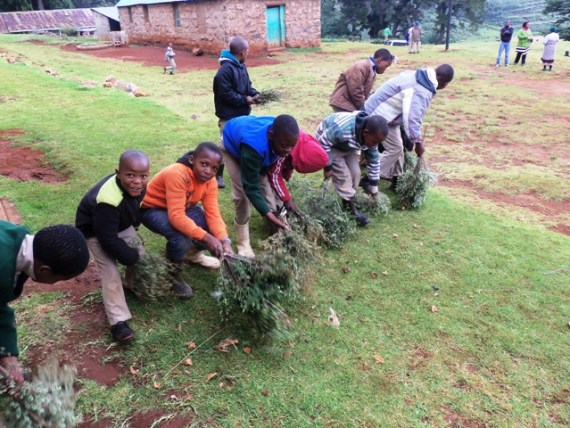
Fridays are always “cleaning” days, and the children in each grade run into the woods to get branches to sweep the floors in their classrooms and the front yard. They sweep the staff room, and attempt to dust the tables in the staff room with a dirty rag.

children
Sweeping the grass while the teachers stand and watch

Can you imagine asking our 1-3 year-olds in America to entertain themselves and our primary school children to clean the floors and sweep the grass?

Please Help Me Raise $5,000 to Make My School Safe

October 13, 2016 by Sonia Marsh 2 Comments

us_5000_1934_federal_reserve_note

I need your help to raise $5,000 to improve the safety and education of students at my rural school in Lesotho, Africa.

CLICK HERE TO DONATE TO MY PROJECT IN LESOTHO

(Scroll Down Until You Reach S. Marsh)

All donations are sent through the Peace Corps and are

TAX DEDUCTIBLE DONATION

Your donations will go through the Peace Corps Partnership Program funds website.

My community has agreed upon the following 3 priorities to help our school.

compound-noun-classroom-working
Collapsed ceiling in Grade 5

1). Make a safe classroom environment for 5th grade students.

Half the roof and ceiling collapsed in July, due to the unusually heavy snow storm, and I’m worried about our safety.

Students want to learn computer skills

2). Electrical wiring of all classrooms to teach computer skills.

My village now has electricity, however, the classrooms have not been wired due to a lack of funds. Since we received four desktop computers from the Minister of Energy, the teachers and students would like to learn how to use them.

Cracks on cold cement floors in classrooms

3). Install vinyl tiles on the floors in all classrooms.

Only the staff room and grade 7 have vinyl floor tiles, all other classrooms have cracked, cement floors which are icy-cold in the winter, and hazardous throughout.


I’d like your help to raise $5,000 and get the work completed by November 30th, 2016, before the Christmas holidays.

CLICK HERE TO DONATE TO MY PROJECT IN LESOTHO

(Scroll Down Until You Reach S. Marsh)

All donations are sent through the Peace Corps and are

TAX DEDUCTIBLE DONATION

PLEASE SHARE WITH OTHERS WHO MAY BE INTERESTED IN HELPING.

The children, teachers, community (AND ME) are all extremely grateful to you for helping us make the school a better place.

I shall post updates and photos once we receive the funds, and start the 3 phases of the project.

You can also follow our progress on my FaceBook  if you’d like.

THANK YOU SO MUCH.

Sonia


The Queen of Lesotho Works Out at My Gym

October 8, 2016 by Sonia Marsh 3 Comments

800px-queen_masenate_mohato_seeiso

Queen ‘Masenate Mohato Seeiso of Lesotho

I’ve never met the Queen of Lesotho, but I knew someone important had arrived at my gym when two black, official-looking cars pulled up at the back entrance to my gym in Maseru.

The first car was an Audi, and the second a Mercedes. Five people climbed out; two well-dressed women in high heels, and two men in business suits. They whisked a third woman, dressed in gym attire, out of the Mercedes, and headed full-speed to the private entrance.
As I sat on my stationary bike, I watched them scurry along and climb the stairs to another set of bicycles overlooking the swimming pool below.

gym4
Stationary bikes overlooking the pool below

The well-dressed women and the two men followed the lady in gym attire to a bike where she promptly covered her head with a black towel, and another woman in gym clothes joined her on the adjoining bike. It was then that I assumed she must be the Queen of Lesotho.
I watched her ride the bike, and assumed that the woman next to her was her personal trainer, despite being quite overweight.
After I finished warming up on my bicycle, I headed over to the Mosotho woman I’ve become friends with who works at the gym and asked, “Is that the Queen of Lesotho working out?”
“Yes,” she said. “She works out with her trainer, and the King comes later.”
“I’m surprised they don’t have their own gym,” I said.
“Oh, they’re building a new ‘castle’ I’m sure they’ll add a gym,” she replied.
Those working out upstairs left her alone, and I climbed the stairs to continue my workout. The Queen’s ‘security guards’ stood in different parts of the gym, making sure she was safe.
I used to be a certified personal trainer at 24-hour fitness in California, so I was curious to see what exercises her trainer was making her do.
Since I started working out in Maseru, 99% of Basotho women are doing squats, lunges and leg exercises. I rarely see them working out their upper bodies, and the Queen of Lesotho, was also doing leg press, and hamstring exercises.

gymsoniabetter
Working out with machines in Maseru

I don’t understand why Basotho trainers rarely show women chest, back, bicep and tricep exercises, to balance out the entire body, although I have heard that Basotho women like large behinds.
The Queen of Lesotho worked out for one hour, and after she left, I was curious to see what weight she used for her hamstring exercises. I used the same prone leg curl machine that she used.

I wanted to go up to her, but decided to give her the privacy she deserves. I did not wait for the King to arrive.

« Previous Page
Next Page »
  • Facebook
  • Instagram
  • LinkedIn
  • Pinterest
  • Twitter
  • YouTube

Sign up for my Gutsy Updates

Sign up to receive awesome content in your inbox, every month.

We don’t spam! Read our privacy policy for more info.

Check your inbox or spam folder to confirm your subscription.

Welcome to My New Life

Welcome to My New Life

Do you feel trapped?
Let me Help You Rediscover Your Freedom.
I divorced at 58, and now belong to myself.
If I can do it, so can you!
Let me help you find your purpose and become your own best friend.

Click the cover to buy on Amazon

Recent Posts

  • Why I Quit Dating Apps at 68—And My 35-Year-Old Son Has the Same Problem
  • Solo Cruising Doesn’t Mean You’re Alone
  • Single Woman Cruising Solo

Also Available At:

Latest from the blog

  • Why I Quit Dating Apps at 68—And My 35-Year-Old Son Has the Same Problem
  • Solo Cruising Doesn’t Mean You’re Alone
  • Single Woman Cruising Solo
  • What Does Self-Love Mean to You?
  • Is Divorce a Gift or a Curse?

Top Posts

  • Why I Quit Dating Apps at 68—And My 35-Year-Old Son Has the Same Problem
  • Portraying Pain and Survival in Memoir by Amy Friedman
  • Are women divorcing for frivolous reasons?
  • "My Gutsy Story" by Keren-Niccole Bunnell
  • One Gutsy thing I did in Belize
  • Privacy Policy

Copyright © 2026 · Beautiful Pro Theme on Genesis Framework · WordPress · Log in

Loading Comments...